

Powering the Future
Leading an Ambitious Transformation Designed to Protect Jobs, Attract New Industries, and Redefine What Regional Prosperity Looks Like for Generations to Come.
For more than a century, Muswellbrook has powered New South Wales. Beneath its rolling hills lies one of Australia’s richest coal reserves, while above ground, generations of families have built lives around an industry that has fuelled homes, supported state infrastructure and shaped the identity of an entire region.
Today, however, the community stands at one of the most pivotal moments in its history.
The world’s energy landscape is changing, major coal mines are approaching closure, and regional economies built on traditional industries are facing unprecedented questions about their future. Yet rather than viewing change as a crisis, Muswellbrook Shire Council is embracing it as an opportunity.
Instead of waiting for outside solutions, the council has embarked on one of the most proactive economic transition strategies in Australia, positioning the region as a future hub for advanced manufacturing, renewable energy, agribusiness, data centres and emerging industries that can continue delivering prosperity long after coal production declines.
Leading that vision are Mayor Jeff Drayton and Director of Economic Investment Shaelee Richards, whose shared message is remarkably optimistic: Muswellbrook has spent decades supplying Australia’s energy needs, and now it is preparing to power Australia’s future economy.
A Region That Has Powered a State
With approximately 17,000 permanent residents and thousands of additional workers living temporarily in the region, Muswellbrook has long punched well above its weight economically. The shire has become one of New South Wales’ most important resource-producing regions, supplying approximately a quarter of the state’s thermal coal exports while supporting thousands of highly skilled jobs across mining, engineering, and manufacturing.
The impact extends well beyond the Hunter Valley.
Coal produced in Muswellbrook has generated billions of dollars in export revenue while royalties have helped fund hospitals, schools, roads and public infrastructure throughout New South Wales. At the same time, the region has supplied around 20 percent of the state’s baseload electricity for decades, making it one of Australia’s most strategically significant energy centres.
While mining dominates today’s economy, the region’s story began long before coal became king.
Agriculture, dairy farming, vineyards, and thoroughbred breeding all played significant roles in shaping the community, creating an economy that was once far more diverse before mining expanded dramatically over the past several decades.
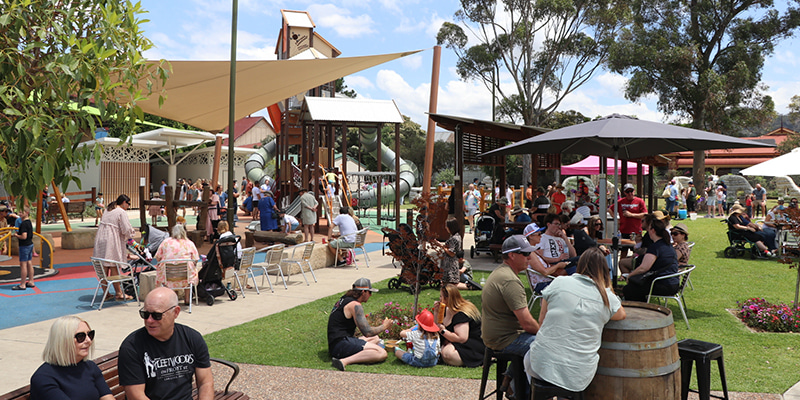
That history is becoming increasingly relevant as Muswellbrook begins writing its next chapter.
“We’ve also provided 20 percent of New South Wales baseload power for the last 50 years or so,” Drayton says. “That’s starting to change, and we’re investing in a whole range of new renewable energy opportunities. That’s our history, and who we are as a place is really founded in coal mining and energy generation. Our economy is about to significantly change, and we’re working really hard on what those future opportunities are.”
Facing Reality Before Anyone Else
Across many mining communities, conversations about transition remain politically charged.
In Muswellbrook, however, council leaders have deliberately chosen honesty over false hope.
Several major coal operations are scheduled to close over the coming years, including the enormous Mt Arthur Mine—currently the largest thermal coal mine in the Southern Hemisphere—as well as the Mangoola operation. Together, they represent tens of millions of tonnes of annual coal production and thousands of direct jobs.
For decades, closures simply meant workers moved to another nearby mine.
That cycle is ending.
Government policy now prevents the development of new greenfield coal mines in New South Wales, fundamentally changing employment prospects for future generations.
Drayton believes that acknowledging this reality early gives the community the best possible chance of preparing successfully.
“I think this is one of the key issues we’re trying to manage,” Drayton says. “We used to confidently say, ‘Don’t worry, there’ll be another job for you.’ We can no longer say that because the jobs just aren’t there.”
Mining has also created another significant challenge. Average salaries approaching $180,000 for many workers have supported an exceptionally strong local economy, but replacing those wages through entirely different industries will require careful planning and realistic expectations.
Rather than pretending equivalent jobs will simply appear, the council has focused on identifying industries capable of creating sustainable long-term employment that builds upon the region’s existing strengths.
Richards says the community itself is also beginning to recognise that the transition is becoming increasingly real.
“In terms of cultural change, there’s been a bit of disbelief that the economy is actually changing,” Richards says. “The workers and the community here just think that coal mining is going to continue. Recently, I think it’s starting to shift to say, ‘Actually, this might be reality.'”
Turning Mining Infrastructure into Tomorrow’s Economy
While mine closures represent significant challenges, they also present extraordinary opportunities that few regions possess.
Across Muswellbrook sit thousands of hectares of industrial land already connected to highways, rail infrastructure, electricity transmission, and water supplies.
Instead of removing that infrastructure during mine rehabilitation, the council is pursuing an entirely different vision.
The objective is to transform former mining sites into Australia’s next generation of industrial precincts.
Richards explains that the region already possesses many of the ingredients future investors require.
“We’re in a really fortunate position where we’ve got state roads to the front of every single mine. We’ve got amazing electricity infrastructure. We’ve got rail infrastructure with additional capacity,” Richards says. “The issue for us is being able to unlock this heavily disturbed mining land for future industry opportunities.”
Rather than allowing billions of dollars’ worth of industrial assets to disappear, Muswellbrook Shire Council is working alongside government and industry partners to develop Australia’s first pilot project aimed at rezoning active mining land before operations cease.
If successful, new businesses could begin establishing themselves while mines are still operating, dramatically reducing the economic gap between coal and whatever comes next.
Drayton believes the opportunity is simply too valuable to waste.
“These mines have massive infrastructure,” Drayton says. “They’re perfectly set up for manufacturing and all sorts of industry. Currently, their consents say everything’s got to go back to grass and trees, but it certainly doesn’t make any sense.”
The pilot project, involving collaboration with BHP along with state and federal governments, represents one of the most innovative approaches to regional economic transition currently underway in Australia.
Rather than rebuilding industrial capability from scratch, Muswellbrook hopes to recycle existing assets into entirely new economic opportunities.
The approach reflects the council’s broader philosophy: transition should not mean abandoning the region’s industrial heritage but building upon it in smarter, more sustainable ways.

Building a New Regional Economy
The physical infrastructure already in place is only one part of Muswellbrook’s competitive advantage.
Equally important is the region’s position within New South Wales’ evolving energy network. As renewable energy projects accelerate across the state, Muswellbrook sits at the centre of critical transmission infrastructure that will distribute electricity from renewable energy zones throughout New South Wales. That combination of reliable electricity, secure water supplies, transport connections and available industrial land is creating opportunities that extend well beyond traditional mining.
For investors searching for locations capable of supporting energy-intensive industries, few regional centres offer the same combination of advantages.
“Energy security, really. That’s the big key,” Drayton says. “All of that generated power from every solar panel, wind farm and every other type of renewable energy comes back to effectively two places in New South Wales, and both of them are in our shire.”
That strategic location is already generating interest.
Council has identified growing opportunities in advanced manufacturing, recycling industries, agribusiness, renewable energy technologies and data centres, sectors that depend on large-scale electricity supply, dependable water resources and transport connectivity.
Rediscovering Hidden Strengths
Although coal has defined Muswellbrook’s recent history, it has never been the region’s only story.
Long before mining reached its current scale, vineyards, agriculture, and thoroughbred horse breeding established an international reputation that still exists today.
The Upper Hunter remains one of the world’s premier thoroughbred breeding regions, while boutique wineries, food producers, equestrian events, and spectacular natural landscapes offer significant tourism potential that the council is now actively promoting.
Richards believes those existing strengths simply need greater visibility.
“We’ve got these other massive industries which are a little bit underappreciated,” Richards says. “We’ve also got amazing natural assets, great walks, lots of historical and Indigenous stories and experiences.”
Events such as the Denman Wine and Food Festival, regional equestrian competitions, and community celebrations are helping introduce visitors to a side of Muswellbrook that extends well beyond mining.
For Drayton, the renewed emphasis on tourism represents both an economic opportunity and a cultural shift.
“I think we’ve probably done it to ourselves,” Drayton says. “We haven’t had to rely on tourism because we’ve always had mining. We’ve been a bit spoilt with that for a while, where we haven’t had to work too hard to bring people into our community because the mining industry did it for us.”
As the economy diversifies, tourism will increasingly complement manufacturing, renewable energy and agriculture, creating a broader and more resilient economic foundation.
Powering Tomorrow
Communities built around single industries often struggle when change arrives.
Muswellbrook has chosen a different path.
Rather than resisting transition, the council is embracing it with a level of strategic planning rarely seen in regional Australia. The foundations that once supported one of the nation’s most productive coal industries are now being repositioned to support advanced manufacturing, renewable energy, technology, agribusiness, and entirely new export opportunities.
The challenges remain significant, but so too do the advantages.
Few places possess Muswellbrook’s industrial infrastructure, energy connectivity, available land, skilled workforce, and willingness to reinvent itself. Those strengths are giving the region every opportunity to replace uncertainty with confidence and build an economy capable of serving future generations.
For a community that has powered New South Wales for more than a century, the next chapter may prove just as important as the last.
Click The Cover To View Or Download The Brochure
AT A GLANCE
Who: Muswellbrook Shire Council
What: The Council that is taking a very proactive approach and cares about the future of the region
Where: Muswellbrook, New South Wales, Australia
Website: www.muswellbrook.nsw.gov.au
PREFERRED VENDORS/PARTNERS

Newcastle University – www.newcastle.edu.au
For over 60 years, the University of Newcastle has been dedicated to education and research. Ranked in the top 1% of universities globally, their degrees are shaped around flexible and transferable skills, work placements and entrepreneurial opportunities. With campuses across Newcastle, the Central Coast, Sydney and Singapore, the University enrols 39,000+ students and is committed to equity and developing socially responsible leaders and innovators.