
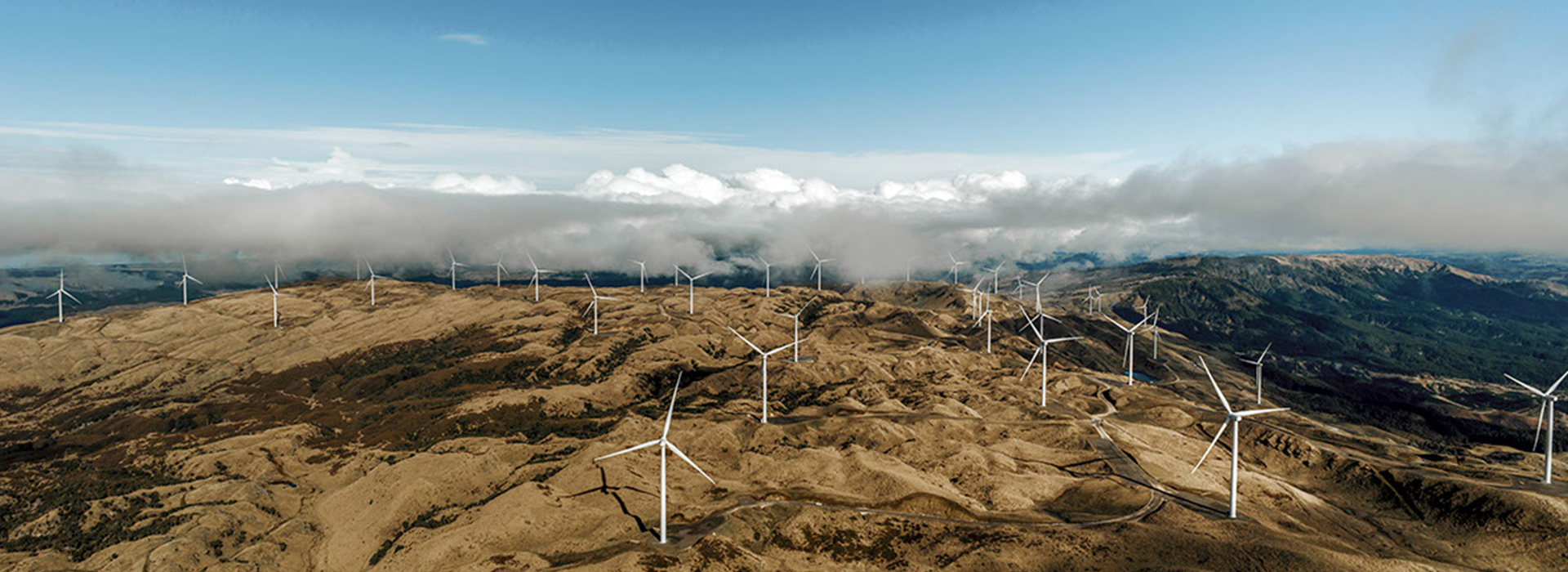
Powering the Next Era of Renewable Growth
The Voice of the Industry Focused on Ensuring Its Members Have the Policy Support, Supply Chain and the Workforce Required to Turn Opportunity into Generation.
More than three decades ago, a single wind turbine on a Wellington hilltop helped demonstrate what wind energy might offer New Zealand. Today, the sector that emerged from that experiment is preparing for growth on an entirely different scale.
The New Zealand Wind Energy Association (NZWEA) traces its beginnings to around 1993 and 1994, when New Zealand’s first wind turbine was commissioned at Brooklyn in Wellington. Designed to test the viability of wind generation, the project became a catalyst for an industry that has since established itself as an important part of the country’s renewable electricity mix.
Today, NZWEA represents approximately 80 to 85 member organisations and around 1,200 to 1,300 individuals. Its membership stretches across the wind energy value chain, encompassing developers and wind farm operators alongside contractors, original equipment manufacturers, engineering consultancies and other specialist organisations.
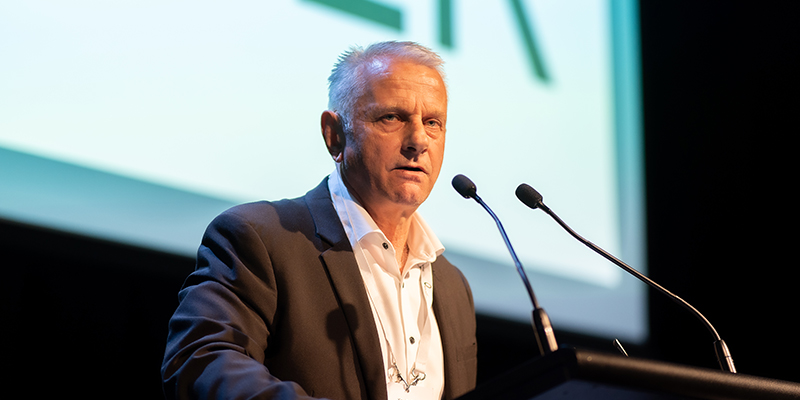
“We’re a long-established organisation, very mature, very well represented. Our members really span the whole value chain of the wind energy sector,” says CEO of NZWEA, Kevin Hart.
Hart joined NZWEA around three years ago, bringing extensive experience from the OEM side of the energy industry. His previous roles included leading General Electric’s Asia-Pacific digital energy business, serving as GE CEO for New Zealand and Papua New Guinea, and heading Alstom Grid New Zealand. Having previously sat on NZWEA’s board, moving into its leadership was a natural progression.
At its heart, the association has a straightforward mandate: Advocate for wind energy to enable a renewable energy future for Aotearoa New Zealand.
“We are the lead advocacy organisation and represent all of our members in various formats,” Hart explains. “We’re here to really ultimately grow the sector; that’s our mandate, and be that voice, that advocacy voice to enable it.”
Creating a Collective Voice
Advocacy takes NZWEA directly into conversations with government officials developing energy policies and standards, as well as key government ministers. The association also identifies barriers that could impede sector growth and work collectively with industry to address them.
For members, however, NZWEA is equally valuable as a place to build relationships and share knowledge. Networking opportunities enable companies to form connections and ultimately participate in an expanding market.
“The real main reason that people join is that they can collaborate and network, but also help to advance the wind energy growth that they’re actually trying to achieve,” Hart says.
Although newsletters and direct correspondence remain part of NZWEA’s communications, Hart sees face-to-face interaction with members as particularly important. The association’s quarterly speaker series brings members together around specific issues, projects and industry developments, while its flagship annual Wind Energy Summit attracts approximately 250 participants.
“We’ve really found that engaging face to face and talking about issues that are relevant to our members – that’s really where you get the impactful outcomes that they’re seeking,” Hart says.
A Market Transformed
The significance of that collaboration is increasing rapidly because the New Zealand wind energy market Hart entered three years ago looks very different today.
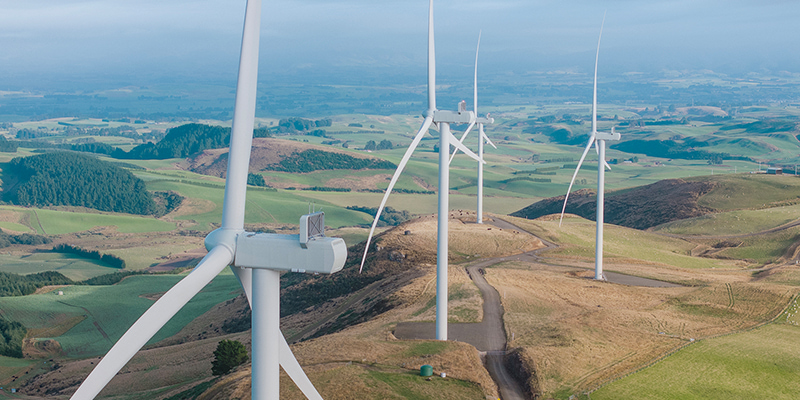
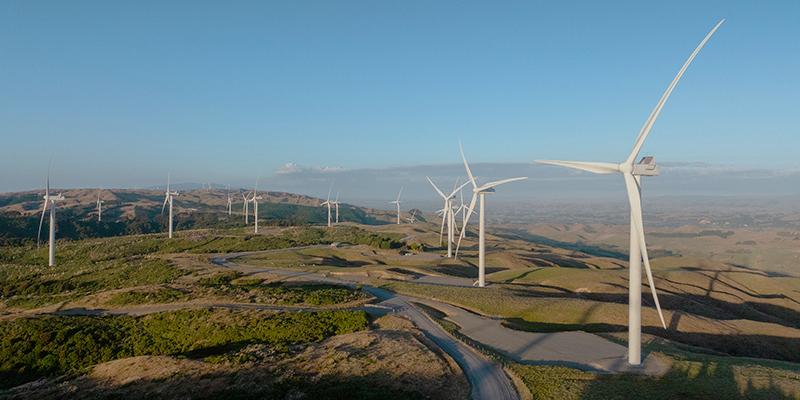
Following a comparatively stagnant period, the energy transition began accelerating development. New Zealand currently has around 1.3 gigawatts of installed wind capacity, built over roughly the past quarter-century. Meeting future demand, Hart suggests, will require the country to construct approximately five times that capacity over the next 25 years, targeting 8 gigawatts by 2050.
The change is already evident in the development pipeline.
“In three short years, I’ve seen the wind energy project pipeline essentially triple. It’s actually more than triple; it’s almost quadrupled in that sort of short timescale,” Hart says.
He can now see approximately seven to ten gigawatts of potential wind projects being progressed, investigated or developed by investors across the market, with 2.5 gigawatts of offshore wind also being considered. This has been kick-started by the parliament’s passing of the offshore renewable energy legislation in July.
That growth is occurring within a country already starting from an enviable renewable electricity position. Hart notes that approximately 91 percent of New Zealand’s electricity generation is renewable, supported particularly by hydro generation, which accounts for roughly 55 percent, alongside geothermal generation and increasing wind and grid-scale solar.
Yet this strong foundation does not eliminate one of the country’s most pressing challenges: maintaining energy security throughout the transition.
Solving the Energy Security Equation
Historically, indigenous gas reserves have provided firming capacity when renewable generation could not fully meet demand. Those gas reserves, however, have declined significantly.
At the same time, New Zealand’s reliance on hydroelectricity creates another vulnerability. During dry years, reduced rainfall can leave hydro lakes below desired levels, restricting the amount of dependable generation available from a resource that has traditionally formed the backbone of the electricity system.
“You’ve not only got a dry-year hydro risk, but you’ve also got dwindling gas reserves,” Hart explains. “So we as a country have got an energy security issue that we all collectively have to lean into and solve.”
The question of how to bridge that gap has become politically significant. Hart says there is broad consensus around continuing renewable development, but greater uncertainty surrounds how New Zealand should maintain sufficient firming capacity while that transition takes place.
For NZWEA, the answer naturally includes getting more renewable projects into operation.
“The one thing that we do have is we have an abundance of renewable energy sources that we can leverage,” Hart says.
Geothermal offers particularly valuable baseload generation, although its lengthy development timelines present challenges when speed is critical. Utility-scale and consumer solar provide further opportunities, while New Zealand’s geography gives wind an especially important role.
Positioned within the powerful “roaring forties” winds, the country possesses an extensive wind resource capable of supporting development in numerous locations.
“A lot of people will ask me, ‘Kevin, where’s a good place to put a wind farm?’ And I say, ‘Well, pick a place in the whole country, and you’re going to be fine,’” Hart says.
Ultimately, he believes the transition will require a portfolio approach rather than reliance on any single technology.
“We need the wind. We need the solar. We need the geothermal. We need the hydros to continue to operate as efficiently and as best that they can.”
Opening the Supply Chain
Having enough potential projects is only one piece of the equation. New Zealand must also secure the equipment required to build them.
NZWEA identified supply chain capacity as a critical industry constraint. Historically, the domestic market had been reliant on one or two European wind turbine OEMs, creating concerns about whether sufficient market competition, product diversity and manufacturing capacity would be available to support the scale of anticipated growth.
The association decided to intervene.
NZWEA took a delegation of developers and investors to China to visit OEMs and factories, examine assets and manufacturing capabilities firsthand, and explore whether additional suppliers could enter the New Zealand market.
Hart describes the experience as eye-opening, particularly given the scale and technological advancement participants witnessed.
“I think that we all came back from that trip pretty excited because we could see that there was opportunity to bring in a new type of OEM, a new class of OEM that we hadn’t previously considered before,” he says.
A year later, Hart says at least three, potentially four, Chinese OEMs are examining the New Zealand market, with some already commercially engaging with developers. Their arrival provides developers with greater choice while creating competitive pressure across the market.
“Competition is a good thing,” Hart says. “It drives down prices. It drives innovation. And it enables us to grow at the rates that we need to grow.”
The challenge has not disappeared. Transformers, substation equipment and cables remain difficult to source globally, meaning supply-chain resilience will remain central to the industry’s ability to deliver its pipeline.
Building the Workforce
Even with investment, equipment and viable projects, another fundamental question remains: who will build them?
After years of comparatively limited development, New Zealand must expand its renewable energy workforce rapidly enough to support a dramatically larger construction program.
NZWEA is beginning to examine training programs capable of attracting people from adjacent industries, introducing young people leaving school to renewable energy careers and supplementing domestic skills with international expertise where necessary.
“Where are these new people going to come from to build this new capacity?” Hart asks. “We’re looking at installing new training processes and training programs to attract people from similar industries into our market.”
Hart describes workforce development as the association’s next major problem statement. If supply chain was the first major barrier NZWEA targeted, skills and human capacity represent the next.
Turning Potential into Power
For an organisation born alongside New Zealand’s first experimental wind turbine, the coming decades represent a remarkable evolution. NZWEA is no longer advocating simply for the viability of wind generation. It is helping an established industry determine how to scale fast enough to support a national energy transition.
The opportunity is substantial. A rapidly expanding project pipeline, exceptional wind resources, growing investor interest and a strong existing renewable electricity base have positioned New Zealand well. But converting those advantages into dependable generation requires policy alignment, competitive supply chains, skilled people and solutions to the increasingly urgent question of energy security.
NZWEA intends to remain in the middle of those conversations, connecting industry, identifying obstacles and ensuring its members have a collective voice as the market expands.
“I’m focused on wind energy playing its part and helping the industry and the sector to grow,” Hart says, “and to see if we can fill the gap as much as we can.”
After 33 years of industry development, New Zealand wind energy is entering a new chapter. The task ahead is no longer proving that wind works. It is building the capability, infrastructure and partnerships necessary to deploy it at unprecedented scale.
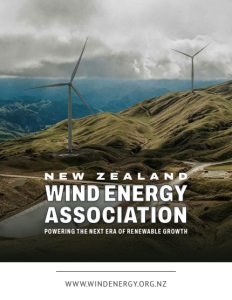
Click The Cover To View Or Download The Brochure
AT A GLANCE
Who: New Zealand Wind Energy Association
What: The industry association representing organisations and professionals across New Zealand’s wind energy value chain.
Where: New Zealand.
Website: www.windenergy.org.nz