Building the Very Best While Constantly Adapting
Redefining Regional Development in Australia
There is a particular kind of confidence that comes from building before the market asks you to.
For many developers, the formula is simple. Wait for the buyer, secure the contract, build the home. It is the traditional rhythm of residential construction, measured by enquiries, approvals, deposits, and demand. But for Hibbard Homes, the rhythm has always been different. For more than two decades, the Australian builder has operated on a model that many in the industry once considered too bold, too risky, or simply too unconventional.
Build first. Create demand later.
It is a philosophy that has not only allowed Hibbard Homes to establish itself across Seventeen regional centres in New South Wales, but has now placed the family-run business at the centre of one of its most ambitious growth periods to date. With expansion into the Hunter Valley, evolving home designs that reflect modern family life, stronger supplier relationships, and plans to move aggressively into land development, the company is entering a new chapter—one defined not just by construction, but by complete community creation.
And perhaps most significantly, it is a chapter being written by four generations of one family.
A Business Built on Taking the First Step
When asked what has changed since the company’s previous interview in 2024, the answer comes quickly: expansion.
Over the past year, Hibbard Homes has significantly strengthened its footprint across regional New South Wales, identifying five major regional hubs including Coffs Harbour, Port Macquarie, Tamworth, Dubbo, and Orange. These larger centres now act as operational anchors, servicing smaller surrounding communities while allowing the business to scale its reach without compromising its regional focus.
But the real milestone has been the company’s move into the Hunter Valley.
Unlike many of the regional areas where Hibbard Homes has historically operated as a dominant builder, the Hunter Valley represents a more competitive landscape. Larger builders already hold established market share. For some businesses, that might be reason enough to stay away.
For Hibbard Homes, it was reason enough to move in.
That move was accelerated when one of New South Wales’ major land development groups approached the company directly, inviting them to bring their speculative building model into a new estate that was struggling to generate buyer traction.
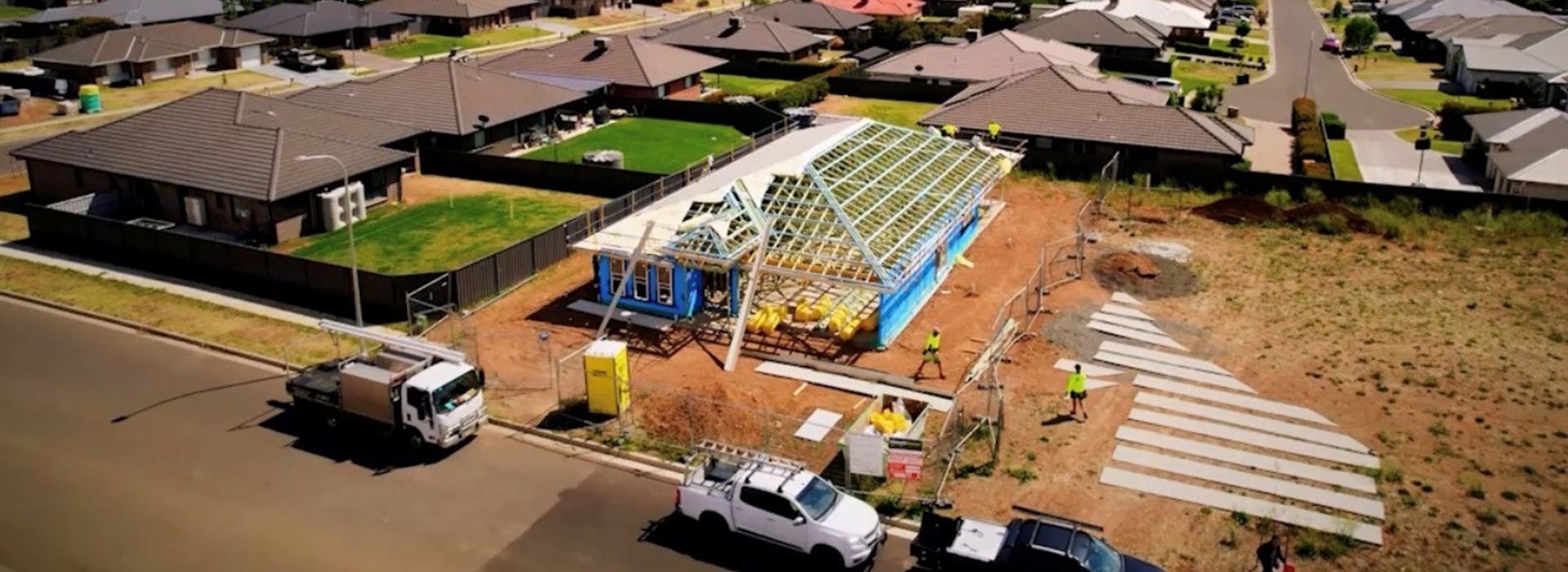
Instead of waiting for purchasers to commit to land, Hibbard Homes did what it has done since 2000. It started building.
“If you build it, they will come,” Hibbard notes.
The strategy worked exactly as intended.
By constructing homes before sales momentum existed, the company helped transform empty streets into active communities. Buyer confidence followed. Interest followed. Sales followed.
It was another reminder that sometimes in real estate, people do not just buy property.
They buy proof.
Regional Growth with Metropolitan Ambition
Expansion into Maitland has become one of the company’s defining strategic moves.
Positioned west of Newcastle, Maitland serves as a gateway into the wider Hunter Valley region, connecting communities such as Singleton and Lochinvar while exposing Hibbard Homes to a new demographic of buyers and investors.
The company’s leadership acknowledges that this move required confidence, but it also validated something they had long believed: their model could compete anywhere.
Rather than relying on customer contracts to trigger construction activity, Hibbard Homes continues to proactively build more than two hundred homes annually across its regions, developing properties independently and releasing them directly into the market. It is a model that allows the business to stay active regardless of short-term market hesitations or fluctuations in consumer confidence.
Even as interest rates and broader economic uncertainty shaped the Australian housing conversation, the company kept moving.
“We’re still charging ahead,” Hibbard explained.
And that consistency has not gone unnoticed.
When Suppliers Back Your Vision
In a post-COVID construction market where supply chains have been tested, and builder confidence has often wavered, Hibbard Homes has experienced the opposite.
Its supplier relationships have grown stronger.
Major building partners, including manufacturers of plasterboard, cladding, and interior products, have reportedly recognised the company’s consistency during a period when much of the industry slowed down.
For Hibbard Homes, this consistency created leverage.
Because the company guarantees high annual build volumes regardless of pre-sale contracts, suppliers have been willing to offer premium product access at pricing usually reserved for much larger volume builders. The result has been an internal transformation of the homes themselves.
What was once considered an above-standard inclusion package has evolved into what Hibbard describes as a “Triple A house.”
Designing for the Modern Family
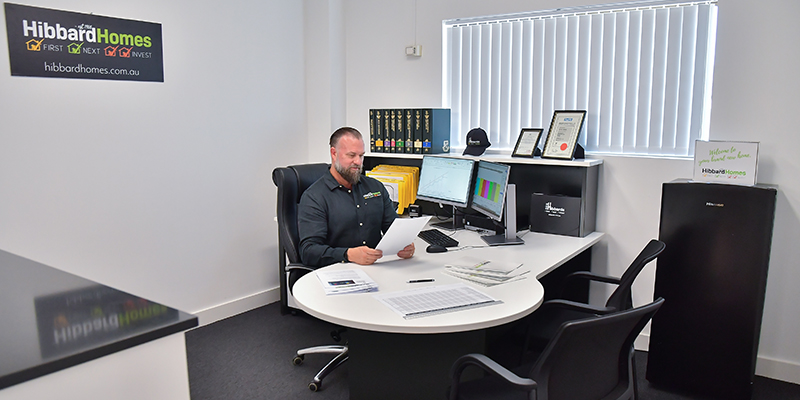
One of the most significant internal changes has been the recruitment of a dedicated interior designer following the retirement of the company’s long-serving colour consultant.
It was a decision that reshaped far more than surface finishes.
According to Hibbard, the designer challenged long-held assumptions about what buyers really wanted—not in terms of floor plans, but in how space is used, how homes feel, and how family life actually functions within the walls of a modern Australian house.
From floor coverings and window treatments to bathroom fittings, kitchen layouts, laundry design, façade presentation, and even the selection of front doors and letterboxes, every detail was reconsidered.
The objective was not simply to make homes look better. It was to make them work better.
“We’re not building something basic,” Hibbard relays.
That philosophy has resonated strongly with buyers. Especially when it comes to one particular floor plan.
The Floorplan That Changed Everything
For years, Hibbard Homes found success with a familiar format. Four bedrooms. Two bathrooms. Two living spaces. Double garage.
It remains one of the most practical and popular family configurations in the market.
But recently, the company introduced something new. A variation that adds a third bathroom and a secondary bedroom suite designed to accommodate changing family dynamics.
The response has been immediate.
“Skyrocketed,” Hibbard says.
The design reflects realities that many builders are only beginning to recognise.
Hibbard points to multi-generational households. Adult children are staying at home longer. He also recognizes the rise of remote work. Older siblings are taking on caregiving roles. Parents supporting young professionals. Families adapting to both economic pressures and lifestyle changes. It is no longer enough to simply provide bedrooms, Hibbard argues. Families want flexibility. They want independence under one roof. And increasingly, they want homes designed for how life actually unfolds—not how housing brochures imagine it should.
Understanding a Changing Buyer
The market itself is shifting.
Hibbard Homes has observed a notable change in buyer behaviour, with owner-occupier purchases decreasing and investor activity increasing. Where the company once saw a seventy-thirty split between owner occupiers and investors, that balance has moved closer to sixty-forty.
Superannuation investment strategies, equity leveraging, and family-based property arrangements are all influencing purchasing patterns. It reflects broader pressures across Australia, but also opportunities.
For Hibbard Homes, it reinforces the importance of building homes that appeal not only to families looking to move in but also to investors looking for quality, longevity, and market-ready appeal.
That dual demand is helping fuel continued sales growth across many of the company’s regions. With lower interest rates helping restore confidence since late 2025, the timing could not be better.
The Next Frontier: Owning the Land Pipeline
If the last two decades were about mastering construction, the next five years may be defined by something far bigger: land development.
Hibbard Homes is now planning multiple subdivision projects across New South Wales, with developments already being prepared for regions including Tamworth. But this is not simply about buying land and building houses. The company plans to internalise the entire process, incorporating town planning, surveying, earthmoving, infrastructure, roadworks, and Council approvals.
Instead of outsourcing these functions, Hibbard Homes wants to control every stage of the development cycle. It is a strategic move born from frustration with delayed external developers, but also from confidence in the company’s ability to execute faster and more efficiently than the existing model allows.
For a company already building at scale, the move feels less like reinvention and more like evolution.
“We know we can do it better,” Hibbard notes.
Four Generations, One Future
Amid all the growth, perhaps the most personal milestone came quietly.
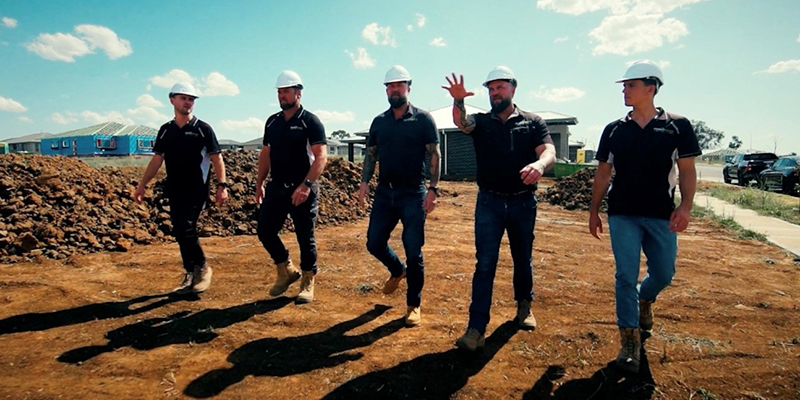
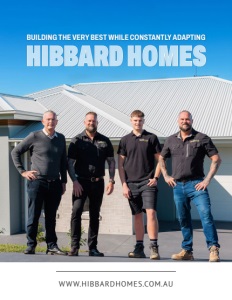
At the beginning of 2024, Hibbard’s son officially joined the business, becoming the fourth generation to carry the family name into the construction industry. At just twenty-one, he is currently training in estimating, quantity surveying, and cost analysis—learning the numbers behind every home before one day helping shape the next era of the business.
For Hibbard Homes, succession is not just a business strategy. It is a statement of continuity. A reminder that while markets shift, designs evolve, and development models expand, the core of the company remains unchanged. It is still a family business, regionally focused and willing to build before anyone else will.
And in an industry where many wait for certainty before they act, Hibbard Homes continues to prove that sometimes leadership is simply having the courage to pour the slab first.
AT A GLANCE
Who: Hibbard Homes
What: A leading and growing homes leader that is committed to the best design, customer service, and construction expertise
Where: Regional New South Wales, Australia, including Coffs Harbour, Port Macquarie, Tamworth, Dubbo, Orange, Maitland, and the Hunter Valley.
Website: www.hibbardhomes.com.au
PREFERRED VENDORS/PARTNERS

Choices Flooring – www.choicesflooring.com.au
With 140+ stores across Australia and New Zealand, Choices Flooring leads in flooring by combining innovation, style and quality. Explore timber, carpets, luxury vinyl, hybrid, window furnishings and more, tailored to your lifestyle. With tools like RoomView and our Inspiration Station, finding the perfect floor is easy. Speak to our experts today and bring your dream space to life!

CSR – www.csr.com.au
CSR Building Products is a major Australian manufacturer supplying plasterboard, insulation, bricks, roofing, facades, and lightweight building systems, known for brands like Gyprock, Bradford, Hebel, Monier, and PGH. Their focus is on innovation, energy efficiency, and sustainable construction solutions.
Boral – www.websitename.com

Laminex Australia – www.laminex.com.au
For more than 90 years, Laminex has been creating beautifully curated decorative surfaces backed by a commitment to design, innovation, quality and sustainability. Designed for a wide range of styles and applications, Laminex products are made to withstand everyday life, with continued investment in Australian made manufacturing and sustainable business practices.

Petries Group – www.petries.com.au
Petries Group is a family owned and operated business, committed to successful long-term relationships with our team, customers and suppliers. Our core purpose is to support customers to make building, renovating and tackling projects simple & rewarding – we’ve been at is for 40 years and counting

Hempel (Wattyl) Australia Pty Ltd. – www.wattyl.com.au
Wattyl is one of Australia’s most enduring and resilient brands. For over 110 years, Wattyl has been empowering people to paint with pride, thanks to our best in class products and expert advice. When it comes to paint, Australian’s say ‘Don’t Worry, It’s Wattyl’