
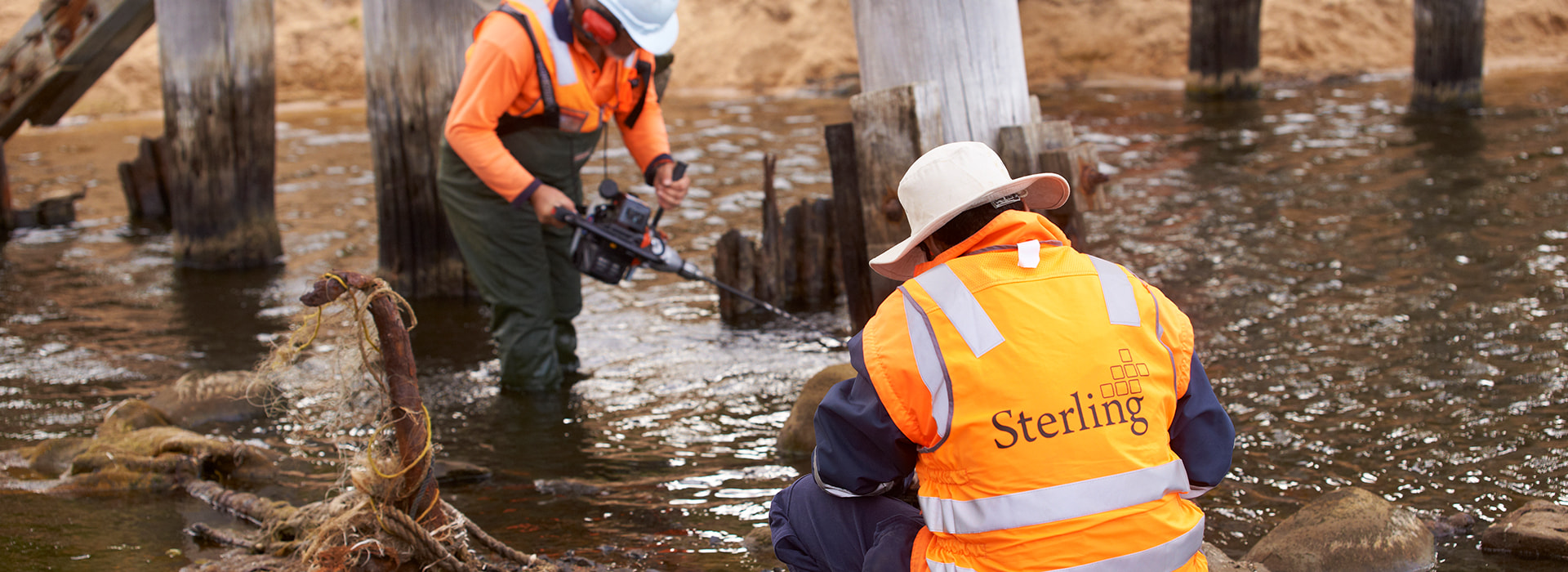
Reinforcing the Critical Infrastructure
Practical Expertise, Digital Innovation, and a Smarter Approach to Asset Management
In the world of transport infrastructure, the most important work is often not about building something new, but about preserving, monitoring, and extending the life of the assets already in place. Across vast rail corridors, road networks, bridges, culverts, and retaining walls, the challenge is not simply one of maintenance—it is one of strategy, precision, and long-term stewardship.
That is where Sterling has carved out a distinctive position.
What began as a small inspection and engineering services business in Melbourne has evolved into a vertically integrated infrastructure specialist delivering end-to-end services across transport asset management. Today, Sterling provides inspection, assessment, design, construction, and maintenance services for critical road and rail infrastructure, combining practical field expertise with increasingly sophisticated digital tools.
At the center of the company’s growth is a simple but powerful philosophy: understand the asset, solve the problem, and deliver the most effective solution possible.
From Modest Beginnings to a National-Scale Business
Sterling was founded in 1998 by Lindsay Donahoo, who left Melbourne’s Public Transport Corporation to establish a business focused on inspection and engineering services within the metropolitan rail network. For many years, the company remained a successful but relatively small operation.
That changed in 2010, when new ownership took the reins.
“We bought into the company at the end of 2009, so we kicked off business under different ownership in 2010,” says Susie Pascoe. “At that time, Sterling was delivering inspection and projects into the metropolitan train network, with around six or seven employees and maintainable revenues of about one to one-and-a-half million.”
From that foundation, the business has grown dramatically. Today, Sterling is on track to generate approximately $70 million in annual revenue, employs around 300 people, and delivers services spanning the full lifecycle of infrastructure asset management.
“The business now delivers end-to-end services into transport infrastructure,” Pascoe explains.
“We inspect structures, assess structures, design structures, construct and maintain structures. If you have a network of rail assets or road assets, we help determine how to best manage those assets.”
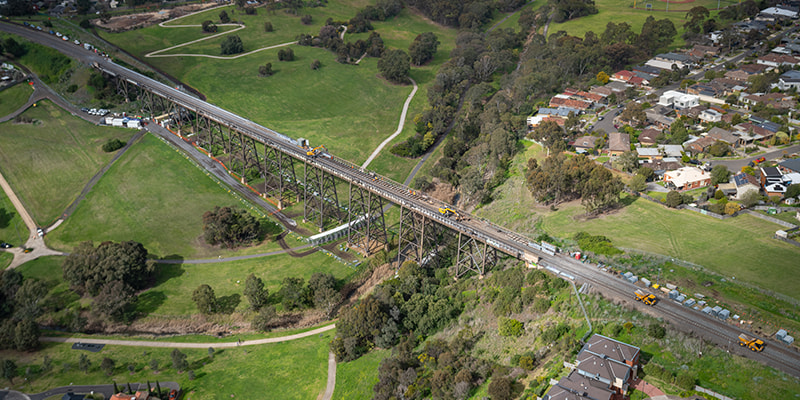
A Different Kind of Infrastructure Partner
Sterling’s evolution has been driven by a clear market position. Rather than competing in the space of major new-build infrastructure, the company has focused on helping owners and operators manage aging assets in the most efficient and cost-effective way possible.
“We are uninterested in playing in the new stuff space,” Pascoe says. “It’s not what we do. We’re a big country with a lot of assets, and if every time we have a problem we replace it with something new, we’re going to run out of money pretty quickly.”
Instead, Sterling has built its brand around the management of deteriorated infrastructure—keeping existing assets safe, functional, and productive for as long as possible.
That position has made the company unusual in its sector.
“We don’t really have a competitor in the full end-to-end model,” Pascoe says. “We certainly have competitors in every component of it, but what makes us unique is that we can hold the whole cycle.”
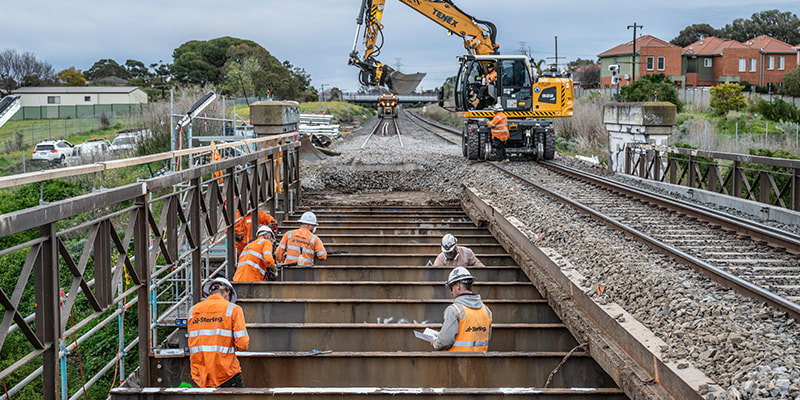
That cycle includes inspect-maintain and design-construct capabilities. Sterling can assess an asset, determine what is needed, design the repair, carry out the works, and then maintain the structure over time. This vertically integrated approach offers a major advantage to transport operators seeking consistency, speed, and accountability.
In rail, in particular, that capability is critical.
“If you want to fix anything on a rail corridor, you’ve got to be in and out,” Pascoe notes. “You’ve either got to work after last train and before first train, or you’ve got to shut the track down—and nobody wants that. So everything has to be designed so it can be delivered efficiently and safely in very short windows.”
Practical Professionals with Rolled-Up Sleeves
Sterling’s point of difference is not just the breadth of its services, but the mindset of its people.
“We describe ourselves as orange-shirt, rolled-up-sleeves professionals,” Pascoe says. “We know we’re competing with white-collar engineers who sit in offices. Our people are practical. We see ourselves as the clever, practical people.”
That practical intelligence runs through the business. Sterling’s teams are made up of people who understand how infrastructure actually behaves in the field—engineers who know construction methodologies, inspectors who understand deterioration patterns, and site teams who can solve problems in real time.
This is especially important in transport infrastructure, where time, access, and operational continuity are constant pressures. The company’s experience in rail has shaped a deeply practical DNA that now applies across road, freight, and mine-to-port corridors as well.
“We know the right tool for the problem,” Pascoe says. “We work with our clients to balance compliance needs, risk needs, and cost needs. You can’t just keep throwing money at a network.”
Technology is Changing the Game
As infrastructure owners face growing pressure to improve safety, manage budgets, and extend asset life, digital tools are becoming central to smarter asset management. Sterling has embraced that shift, investing heavily in technology while also acknowledging the realities of an industry still governed by legacy compliance standards.
Historically, transport assets were managed through scheduled physical inspections. Bridges, culverts, retaining walls, and other structures had to be manually checked at regular intervals, often with full engineering reviews required every five years. While those requirements remain in place in many cases, technology is rapidly changing how inspections and assessments are performed.
“With the influx of technology, you don’t really need an experienced inspector checking every component of every asset anymore,” Pascoe explains. “You can send a drone, you can put monitoring on the bridge, you can create a digital twin, and you can see how the asset is behaving over time.”
Sterling now uses a range of digital tools—including drones, 3D imaging, monitoring systems, dashboards, and digital twins—to improve accuracy, consistency, and planning.
These tools help eliminate some of the variability that comes with traditional inspections and allow asset owners to compare condition data over time in a much more meaningful way.
“If you have ten different inspectors, they’re not always taking the same photo,” Pascoe says.
“But if you have a digital twin and repeat the same capture every year, you get a much better understanding of how something is changing.”
The result is not just better inspection data, but smarter long-term decision-making. Digital systems allow clients to identify deterioration trends, understand environmental impacts, and plan maintenance over two-, five-, or ten-year timeframes.
At the same time, Pascoe is candid that digitization remains a journey.
“In some respects, digital tools have both helped and hindered, because the standards still require physical inspections in many cases,” she says. “So sometimes you’re doing both—sending a drone and sending an inspector—which can duplicate effort. But it’s an investment in bringing clients and regulators on the journey.”
Investing in Capability
To support this evolution, Sterling is making significant investments not only in equipment and technology, but in the people who can bridge the gap between field operations and digital innovation.
“We’re investing significantly in equipment and technology, and in people who have those capabilities,” Pascoe says. “Because of our background, we have a lot of practical people who can walk out on track and practical engineers. What we’re investing in now are people who have the technology capability to match the two.”
That includes drone pilots, digital modelers, monitoring specialists, and external technology partners who can enhance Sterling’s service offering.
One standout relationship is with Australian Spatial Analytics, a social enterprise that helps manage large volumes of infrastructure data while creating career pathways for neurodivergent individuals.
“It really works to have a partner who is creating pathways for a different category of people and who are reinvigorated by that kind of work,” Pascoe says.
It is a partnership that reflects Sterling’s wider belief in practical collaboration and mutually beneficial relationships.
“We like solving problems together,” she adds.
A Family Business with a Long-Game Mindset
Despite its size, Sterling continues to operate with what Pascoe describes as a small business mindset.
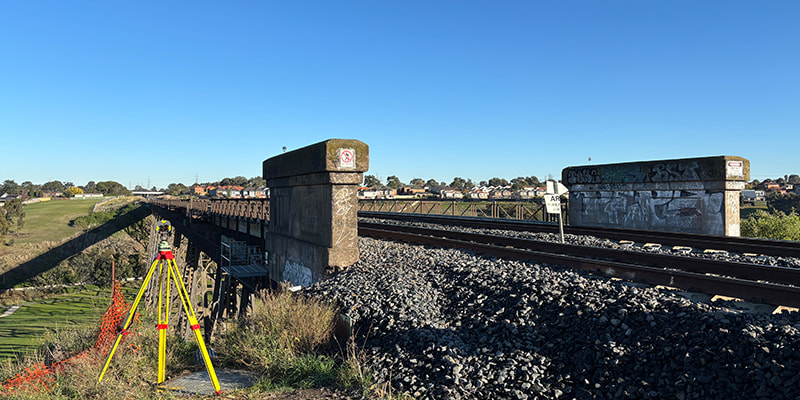
“We know everyone by name. We see ourselves as relationships first, practicality first, and agility first,” she says.
Owned by Pascoe, her husband, and her brother-in-law, Sterling is very much a family company, and that identity continues to shape its culture. The leadership team works hard to maintain an environment where people feel seen, supported, and encouraged to grow—even as the business scales.
“The whole idea is to keep the business small in mindset and family in values, even as we get bigger,” Pascoe says.
That culture has translated into real career development opportunities. Graduate engineers have grown into project managers. Site workers have been supported through engineering or construction management pathways. Junior staff have gone on to hold major roles within client organizations.
“We want people to have the best experience they can have here,” Pascoe says. “This is a long game. We’re not here for next year. We’re here for the journey.”
Maintaining that culture is not without challenges, particularly in a 300-person organization where not every employee will engage at the same level. Still, Sterling remains focused on building a workplace where values are modeled, not merely stated.
“Words mean very little,” Pascoe says. “You’ve got to be able to live it and breathe it and authentically love it.”
Geographic Growth and Strategic Expansion
Looking ahead, Sterling’s major strategic priority is geographic expansion.
Historically Melbourne-based, the company has also operated in Rockhampton and has now formally launched an office in Brisbane, positioning itself to support growing infrastructure demand in Queensland—particularly as preparations accelerate for the 2032 Olympic Games.
“It’s a place to be at the minute,” Pascoe says. “There’s obviously a lot of infrastructure work being done to prepare for the Olympics.”
The company is also planning to move into Sydney within the next 12 months, taking its transport asset management model into new markets while preserving the Sterling culture that has driven its success.
“One of the things we’ve found is that when you go geographically, you need to take some people with your DNA into that new state and then bring in local people,” Pascoe explains. “If you just bring in new people to run it, they don’t really embody who you are.”
That measured approach to expansion reflects Sterling’s broader philosophy: grow with intention, stay true to the brand, and remain focused on what it does best.
For Sterling, that means continuing to deliver practical, intelligent solutions for aging infrastructure—helping clients maintain vital networks, manage risk, and make better long-term decisions.
In a sector often drawn to the new and the next, Sterling is proving the enduring value of looking after what already exists.
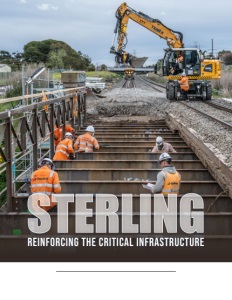
Click The Cover To View Or Download The Brochure
AT A GLANCE
Who: Sterling
What: Providing inspection, assessment, design, construction, and maintenance services for critical road and rail infrastructure
Where: Melbourne, Victoria and Queensland with plans for NSW.
PREFERRED VENDORS/PARTNERS

Australian Rollforming – www.ausrollform.com.au
Australian Rollforming Manufacturers (ARM) demonstrates how local engineering and manufacturing experience drives infrastructure success. Its collaboration with Sterling Infrastructure on the Moonee Ponds Creek Rail Bridge highlights innovation, efficiency, and risk reduction. ARM’s precision manufacturing and forward-thinking design strengthen supply chains while delivering cost-effective and consistent outcomes for Australian industries.