

Redefining Water Infrastructure
Delivering Results Through Innovation, Scale, and Strategic Partnership
In Western Australia’s mining sector, water infrastructure is not simply a support function—it is a mission-critical component of operational continuity, environmental responsibility, and long-term growth. As mine sites expand and infrastructure demands intensify, contractors are being asked to deliver faster, smarter, and with greater certainty than ever before.
For PPS Water Group, that challenge has become an opportunity.
What began as the acquisition and reinvention of a struggling legacy business has quickly evolved into one of the most dynamic water infrastructure contractors operating in the mining sector today. Under the leadership of founders Matt Rear, Chief Executive Officer and Managing Director, and Aaron Huggett, Chief Operating Officer, PPS Water Group has grown at remarkable speed, building a reputation for technical capability, rapid execution, strong culture, and a willingness to challenge conventional contracting models.
Now, with revenue climbing, technology investment accelerating, and a major joint venture strategy underway, the company is entering its next chapter with momentum.
Rebuilding with Purpose
The origins of PPS Water Group lie in both disruption and opportunity.
Before launching PPS Water Group, the business operated as an independent water infrastructure contractor that was later purchased by Plummers Industries during the delivery of a major project to ensure continuity of the work. Plummers Industries continued operating the business for several years between 2016 and 2022.
In August 2022, Rear acquired 50% of the company from Plummers Industries, and by June 2023, he and Huggett had formally rebranded and relaunched the business as PPS Water Group.
“We had to remarket it and give it a new face,” Rear explains. “When we bought the company, it was doing between $14 million and $18 million of revenue per annum.”
The turnaround that followed was swift.
Using their industry knowledge, long-standing client relationships, and a clear growth strategy, the team scaled the company dramatically. In its first year under the new direction, revenue climbed to around $40 million. By the following year, PPS Water Group had exceeded $100 million in annual revenue, and leadership expects that scale to continue, with future growth targeted at roughly 20 percent year over year.
“We scaled it quickly, but with a plan around capability, delivery, and where we wanted to position the business,” Huggett says.
Focused on Water Infrastructure for Mining
PPS Water Group operates primarily in water infrastructure projects within the mining sector, with the bulk of its work concentrated in the Pilbara region of Western Australia. The company is listed as a tier one contractor for Water Corporation, although its main focus is not municipal work. Instead, the business remains heavily engaged with major mining clients, including FMG, Rio Tinto, and BHP, along with several other operators.
The company’s core services span a broad range of water-related infrastructure, including dewatering systems, bores, bore headworks, overland pipelines, pump skids, valve stations, and associated water infrastructure.
“Our bread and butter is really the HDPE overland pipelines and large-diameter pipe infrastructure,” Huggett says.
While larger tank components are often subcontracted, PPS Water Group executes most of the piping and electrical works directly, supported in part by manufacturing capabilities from partner company Plummers Industries, which continues to retain a significant ownership stake in the business.
The result is a contractor that combines self-perform delivery capability with deep sector knowledge, allowing PPS Water Group to maintain control over quality, schedule, and outcomes in some of the most challenging operating environments in Australia.
Technology as a True Differentiator
A defining feature of PPS Water Group’s rise has been its aggressive commitment to innovation and technology investment.
Leadership saw early on that if the company was going to distinguish itself in a competitive and often margin-compressed market, it needed real operational points of difference. That thinking has led to substantial investments in both physical equipment and digital tools.
“We’re big believers in innovation and technology,” Huggett says. “We’ve certainly seen a swift shift in the artificial intelligence world, and we’re actively using it to support our project engineers.”
Across the business, artificial intelligence is being applied in practical ways. PPS Water Group uses AI tools to assist with specification compliance, quick-reference support for project teams, contractual interpretation, and pre-contract reviews, with bots configured around client-specific procedures and internal commercial requirements.
The company is also using augmented reality and geo-located field software that allows engineers and work crews to access critical documents, data, and work packs in real time from mobile devices—even when operating far from site offices.
“If our offices are set up 100 kilometers away from our work site, and someone gets out there and has left something back at the office, we can basically land a drawing out there for them,” Rear says. “That’s been a big shift in our workforce efficiency.”
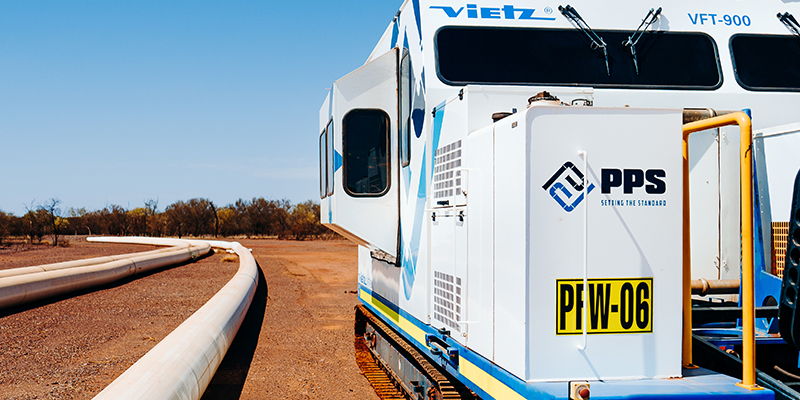
On the equipment side, PPS Water Group has invested heavily in specialized pipeline construction machinery, including advanced units sourced from Germany that significantly reduce labor requirements and improve productivity in extreme field conditions. According to Rear, the company now operates multiple highly specialized machines and has committed around $10 million to this technology over the past three years.
“That technology has really set us apart,” he says. “Where competitors might need five or six people per crew on a pipeline welder, we only need one or two.”
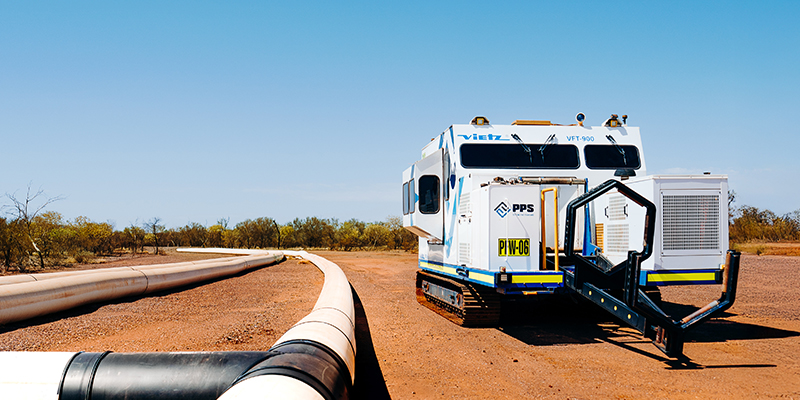
Those machines also offer an added advantage in Western Australia’s harsh climate, with air-conditioned operating environments helping improve safety and comfort for crews working in extreme heat.
PPS Water Group’s commitment to innovation is formalized through an internal technology steering committee, which regularly reviews opportunities ranging from AI-driven office automation to more advanced future possibilities such as robotics and digital workflow integration.
“Nothing is really off limits,” Huggett says. “We’re keeping a close eye on everything.”
Building Culture During Rapid Growth
Rapid growth can often place enormous strain on company culture, particularly when headcount expands quickly, and operational complexity rises at the same time. PPS Water Group has experienced exactly that dynamic.
When Rear took over the business in 2022, the company had just a handful of office staff and a small site workforce. Today, the business employs more than 200 direct staff, with an additional 100 to 200 subcontractors and peak labor personnel depending on project demand. At any given time, the total workforce numbers can range from approximately 275 to 450 people.
That level of growth in a short timeframe has made culture both a challenge and a priority.
“We’ve had rapid ingestion of people, and maintaining culture has been quite challenging,” Huggett says. “But I think we’ve done a really good job coming out the other side.”
Leadership describes the culture as output-driven, transparent, respectful, and high-paced.
The company supports flexible work arrangements where practical, but still sees value in teams working side by side in office environments, particularly when speed, collaboration, and problem-solving are essential.
“We focus on outcomes rather than hours,” Huggett says. “We’re very much output-driven.”
One of the company’s cultural differentiators is the degree of internal transparency it tries to maintain. Employees are given meaningful visibility into the direction of the business, the status of projects, and what is happening across departments.
“Something that annoyed me in previous companies was not seeing or understanding where the business I was working for was going,” Huggett says. “So within reason, and with a lot of context, we provide our employees a great deal of information.”
That openness is reinforced by a clear internal identity built around the acronym PIPES: Pride, Integrity, Passion, Efficiency, and Safety.
“It’s easy for people to remember,” Rear says.
The company has also invested heavily in branding and internal messaging to ensure that its strategic direction is understood not just by clients, but by employees as well. Among the company’s key internal messages is a simple but ambitious standard: “At PPS, we set the standard for the industry.”
According to leadership, that message has been embraced across the workforce and reflected in both employee engagement and client feedback.
“We partner with our clients to deliver outcomes, not just scope.” Rear says. “It’s not always about price.”
Developing the Next Generation
Alongside growth and delivery, PPS Water Group is also becoming increasingly focused on employee development and career progression.
Leadership sees a clear gap in the current labor market, particularly in the mining and infrastructure space, where years of pressure, standardization, and cost-cutting have often left younger professionals under-mentored and insufficiently rounded in their project experience.
“We’re really looking at becoming a bit of a training ground for those personnel,” Huggett says.
The company has begun building internal development programs for junior project managers and project engineers, while also establishing relationships with universities to attract emerging engineering talent into placements and early-career pathways.
“There’s definitely been a labor shortage of skilled professionals in our industry,” Huggett says. “We want to close that gap.”
This development focus is especially timely as many experienced industry veterans begin to retire, leaving the sector with an urgent need to transfer knowledge, rebuild capability, and train a new generation of technically sound and commercially aware professionals.
Reshaping the Contracting Model
Perhaps the most significant strategic development underway at PPS Water Group is its move toward a new contracting model, supported by a strategic partnership with Xylem, the global water technology company listed on the New York Stock Exchange.
For Rear and Huggett, this initiative is about far more than a single commercial relationship. It is a deliberate attempt to reshape how water infrastructure projects are delivered in the Australian mining sector.
Historically, contractors like PPS Water Group have often entered projects during the execution phase, after design decisions, equipment selections, and many cost assumptions have already been locked in by engineering houses and consultants. In leadership’s view, that model has become increasingly inefficient and commercially unsustainable.
“The engineering houses are running in between the mining companies and us, and it’s very hard to work in this space,” Rear says.
The new model seeks to address that problem by involving PPS and Xylem earlier—during feasibility studies, preliminary engineering, product selection, and early contractor engagement—so that construction knowledge, OEM capabilities, and schedule realities can all be aligned from the outset.
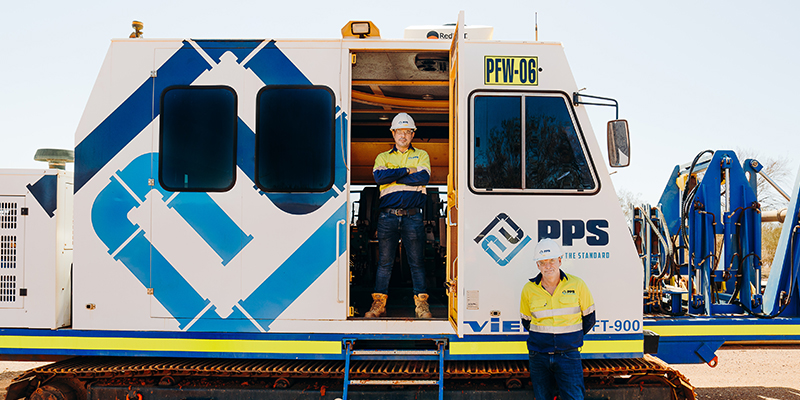
“We’re really trying to get ahead of that curve and get right in early contractor engagement,” Huggett explains. “That helps with product selection, construction opportunities, schedule opportunities, and non-duplication of drawings.”
The logic is straightforward: by aligning contractor, OEM, and client earlier in the process, projects can move faster, reduce redesign and duplication, improve lead-time control, and deliver better macro-level outcomes.
Leadership is already seeing strong interest from mining clients with this model.
“We’re trying to become the master of our own destiny,” Rear says. “The traditional model just isn’t sustainable.”
For PPS Water Group, the Xylem relationship could also become a major growth accelerator, opening the door to a new scale of project delivery and broader market positioning.
Growth with Stewardship in Mind
Although PPS Water Group is firmly growth-oriented and commercially focused, leadership is equally clear that the company’s work sits within a much larger conversation around water stewardship.
Water is a finite and increasingly sensitive resource, particularly in the regions where PPS operates. As mining companies face growing environmental expectations and scrutiny around their social license to operate, contractors are also being asked to contribute to better resource management outcomes.
“We want to be at the forefront of that and help sustain and better manage those resources,” Huggett says.
The company’s leaders note that Indigenous communities in the Pilbara have a deep awareness of waterways, water movement, and long-term environmental balance, and PPS Water Group sees respect for those realities as an important part of its role.
“There’s a responsibility,” Huggett says. “It’s about leaving water there at the watering hole for the next person.”
That perspective adds a broader purpose to the company’s work. PPS Water Group may be building infrastructure for some of the largest mining companies in the world, but it is doing so in a context where water management must increasingly balance productivity, stewardship, and future access.
Vision for 2026 and Beyond
Looking ahead, PPS Water Group’s vision is bold.
Leadership sees the company continuing to grow strongly through 2026 and beyond, supported by a robust project pipeline, scalable internal systems, and a more stable operational platform after several years of intense buildout and transition.
“We’re starting to see the fruits of that labor,” Huggett says.
The business now believes it has the infrastructure to scale project delivery between $80 million and $200 million annually, with future growth driven primarily by additional project teams rather than by major new overhead layers.
At the strategic level, however, the bigger ambition is to prove and expand the new contracting model developed through the Xylem relationship. Leadership believes this approach could eventually create a business of much greater scale—one capable of reaching new revenue thresholds without sacrificing profitability or discipline.
“The vision is to move forward with a big group like Xylem and do a different contracting model that Australia hasn’t seen before,” Rear says.
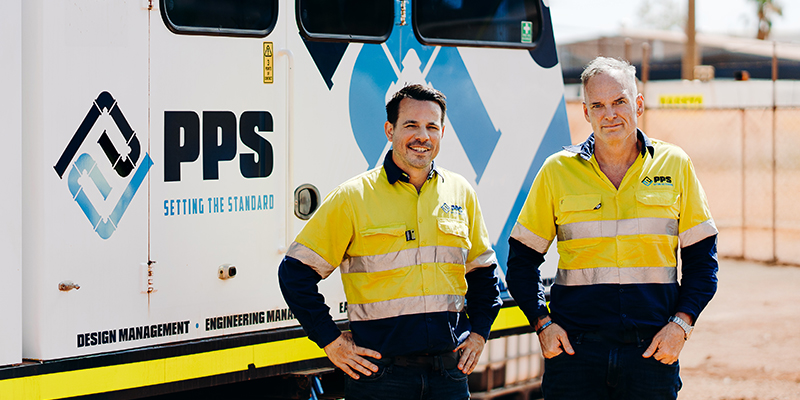
For PPS Water Group, that future is not just about getting bigger. It is about building a more sustainable, more technologically advanced, and more commercially intelligent model for delivering water infrastructure in the mining sector.
And if the company’s first few years are any indication, it is moving toward that future at full speed.
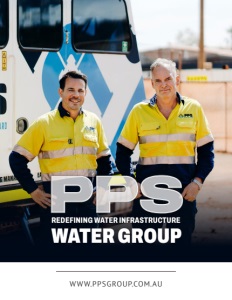
Click The Cover To View Or Download The Brochure
AT A GLANCE
Who: PPS Water Group
What: Specializing in water infrastructure projects within the mining sector, throughout the Pilbara region of Western Australia
Where: Pilbara region of Western Australia
Website: www.ppsgroup.com.au
PREFERRED VENDORS/PARTNERS

EMJC Earthingmoving And Plant Hire – www.emjcplanthire.com.au

MTA Transport – www.mtatransport.com.au
McHaffie Transport Australia exemplifies reliability in remote freight logistics. With deep mining sector expertise and a strong safety culture, MTA delivers sensitive cargo with precision. The MTA team has the experience and values that underpin the tailored, professional service, positioning the company as a trusted partner across Western Australia’s demanding transport landscape and beyond.

Xylem Water Solutions Australia – www.xylem.com
Xylem is a leading global water solutions company dedicated to advancing sustainable impact and empowering the people who make water work every day. From moving, treating and measuring water to optimizing and maintaining water systems, Xylem collaborates with customers to solve their most critical challenges. Together, we are building a more water-secure world.

Dravus – www.dravus.com.au
Dravus is built on project delivery experience in the mineral processing sector. Our expertise spans the full life cycles of asset readiness, from completions and commissioning to ramp up, optimisation and operational handover. With experience across lithium and other mineral processing infrastructure we have become a go to partner for major resource operators.